I Dreamed: The Rod Lauren Story

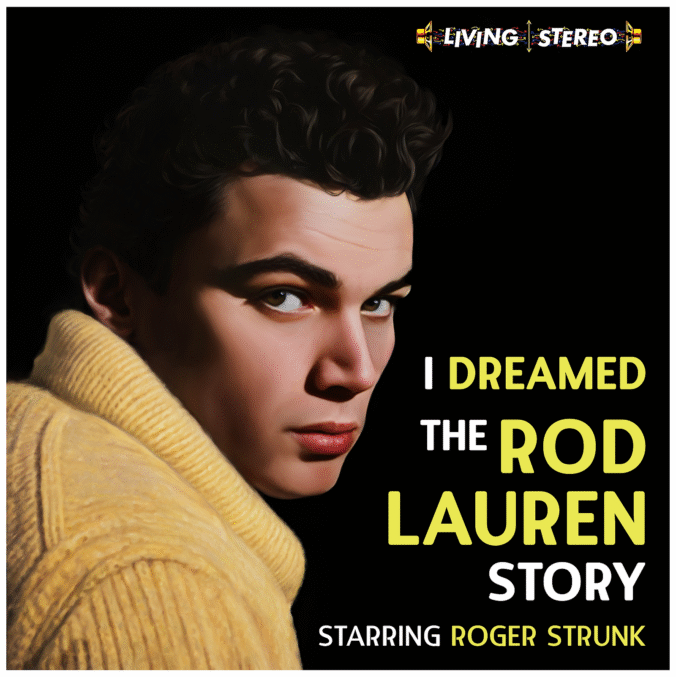
Here is a million-dollar baby. Maybe.

This is the picture: Male, five-eleven, the muscular physique of “Mr. America” and brooding, dark good looks reminiscent of the late James Dean.

Talents: Acting and singing.

Personality: Partly cloudy, with occasional thunder.

Name: Rod Lauren.

And maybe he will be the biggest star of the coming decade.

– “Birth of a Star” by Martin Cohen
TV-Radio Mirror, October 1960


On the day he was born – on March 26, 1940, in Fresno – his parents named him Roger Lawrence Strunk.

By the time he turned twenty, he would be heard on radio stations across the United States (as well as in Canada, Great Britain and several other countries), written about in newspapers and magazines – from his hometown Tracy Press to Life, Time, and Parade – and seen on national television with Ed Sullivan, Bob Hope, Perry Como, Steve Allen and on Dick Clark’s “American Bandstand,” known now as “moody, sullen-faced” Rod Lauren.

This is the story of Rod Lauren, and of Roger Strunk.

Continue reading
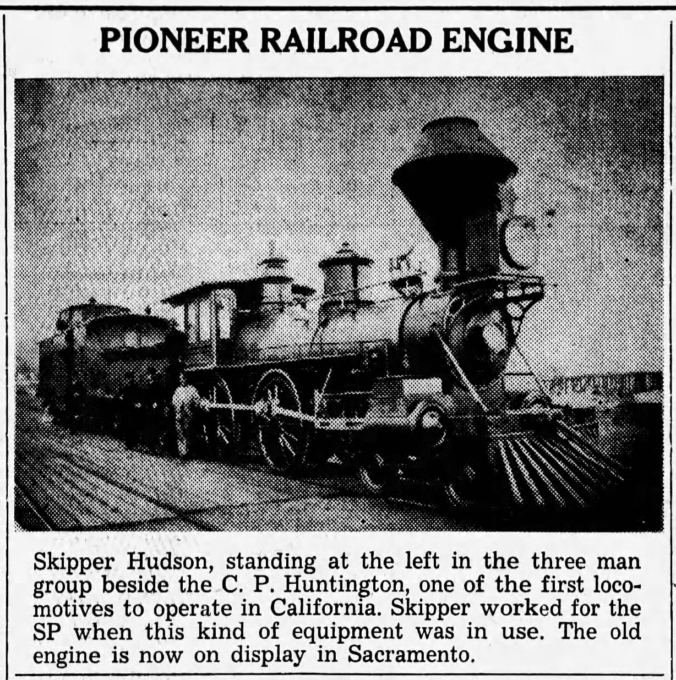
The Ballad of Skipper Hudson

From the front page of the September 10, 1944, edition of the Tracy Press:

Skipper Hudson
Laid to Rest
Tuesday

Passes Away Saturday
In Stockton After
Short Illness

Skipper Hudson is dead. The end came early last Saturday morning in a Stockton hospital.

Born in San Francisco in 1859, he lived as an individualist and died the same way, refusing aid from anyone, working for his living until the very end of his life and maintaining the fiery independent spirit after his weary flesh and blood became too weak to carry out the dictates of his mind.

On the evening of March 2 he became ill while sitting in a restaurant. Assisted to his room in the Roberts building by his son, Charles Hudson, and E. C. Wyman, Skipper told his helpers to leave him alone — he would be well and working by morning.

But 85 years had taken their toll. Skipper did not rally. He was taken to a Stockton hospital where he remained only because he did not have the physical strength to get up and leave.

Continue reading

A New Traincam In Stockton

I’ve been agitating for a webcam near the busy Stockton Diamond for years, and now – thanks to SouthWest RailCams and cam host Geiger Manufacturing – we’ve got one.

The traincam is pointed directly from Geiger’s facility toward the Diamond, where Union Pacific and BNSF rail traffic intersects.

Amtrak and Altamont Commuter Express (ACE) passenger trains also traverse the interchange.

Continue reading

Mileposts: Byron Hot Springs (MP 69.9)

Byron Hot Springs, a once elegant and prestigious resort and spa in rural eastern Contra Costa County, a few miles up the Southern Pacific Railroad tracks from Tracy on the Byron Highway to Brentwood and Martinez, now lies in ruins, hidden from view of the thousands of commuters and other travelers that pass it every day of the week.

Byron Hot Springs Ad (Image)

In earlier times, the hot springs were utilized by the local native population for bathing and for the water’s perceived medicinal qualities. Upon the arrival of European settlers in the area, most notably the infamous John Marsh, the natives were driven away or forced into servitude.

The springs were developed into a tourist resort used by the well-to-do from far and wide; it is known that baseball great Joe DiMaggio vacationed regularly at the hotel during the off-season, and numerous stars from vaudeville and the early days of Hollywood movies – including, according to legend, Charlie Chaplin, Fatty Arbuckle, Mae West, and Clark Gable – also sought respite at the resort.

Continue reading

Cornering The Market: Neighborhood Stores In Tracy

AUTHOR’S NOTE: This article is slightly off-topic. There is little, if anything, about trains in this article.

While driving around Tracy, in these days of sprawling supermarkets – Safeway, Raleys, Save-Mart among them – you may not notice the numerous corner markets that dot our town.

Most of these corner markets, several of which aren’t actually on a corner, per se, date back several decades, to a time before the large supermarkets offered one-stop convenience for everything your family needs.

Continue reading

Mileposts: Ayala (MP 70.9)

On the Union Pacific Railroad’s tracks through Tracy, Calif., east of the Tracy ACE station near the corner of Tracy Blvd. and Linne Road, is a mile-long spur at a junction listed on the railway’s timetable as “Ayala.”

The spur predates the  construction of the ACE station, and was put in place by the Western Pacific Railroad to serve a handful of industries in the area off Gandy Dancer Drive near Tracy Blvd. and Valpico Road.

Southern Pacific Diesel Shed, Tracy

For nearly five decades, the Southern Pacific Railroad utilized two massive roundhouses at its railyard near downtown Tracy. The roundhouses were constructed to service and repair steam locomotives at Tracy, which was a major waypoint on the SP during the first half of the Twentieth Century.

SP Tracy Turntable (Photo, Circa Early 1950s)

A view of the SP’s Tracy turntable, looking between the old roundhouses, circa early 1950s.

In the mid-1950s, the Southern Pacific began the complete phase-out of steam locomotives, replacing their entire fleet with more reliable diesel-electric locomotives, which required substantially less maintenance.

Continue reading

Mileposts: Holly Sugar Corp. Refinery, Tracy (MP 73.5)

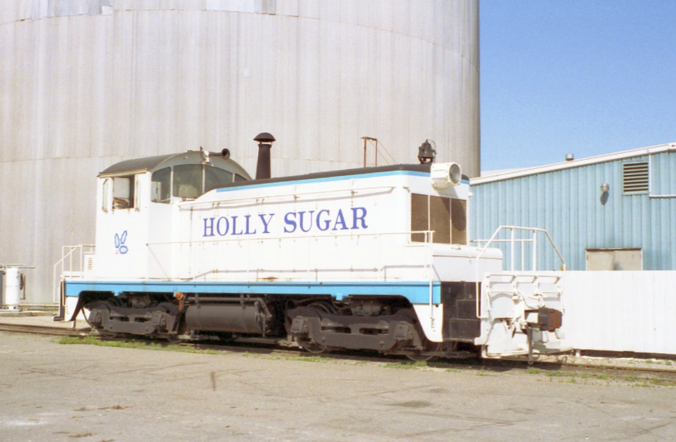
It’s perhaps the most visible landmark across the flatlands of western San Joaquin County – a cluster of tall, white silos bearing the Holly Sugar brand – which can be seen from miles away, towering above the landscape north of Tracy.

The Holly Sugar refinery in Tracy’s rural outskirts went online in 1917 as the Pacific Sugar Corporation. The plant originally received beets by way of trucks, and later via barges that utilized a man-made waterway known as “Sugar Cut” that diverts from Tom Paine Slough and Old River, north of Tracy.

Continue reading

Union Pacific “Mothball Fleet” In Tracy

A recent downturn in railroad revenues has turned the once-busy Union Pacific Railroad yard in Tracy into a pasture of sorts.

The UP’s yard here, which extends east from the Eleventh Street overpass downtown nearly to the town of Banta, has become the “rest home” for about 85 of the railroad’s locomotives that have been put out to pasture, stored here in hopes of a future rebound in freight shipments via rail.

Continue reading

Mileposts: Bethany (MP 75.7)

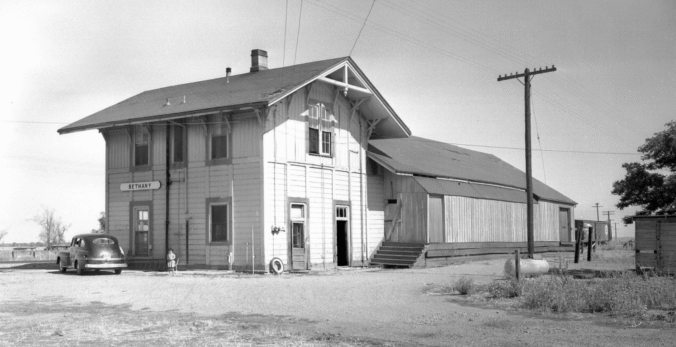
The village of Bethany could, once upon a time, be found along the Southern Pacific Railroad’s Martinez-to-Tracy extension, just a few miles outside the latter city’s limits.

These days, few signs remain of Bethany: an old farm road that ends near the tracks is perhaps the most significant remnant. (A reservoir in the nearby Livermore Hills is named for the town, but is several miles distant.)

The Central Pacific Railroad built a depot at Bethany around 1878 along the route, which was constructed as the San Pablo & Tulare Railroad; in the early Twentieth Century, this section of tracks appeared on USGS maps – including the one below from 1914 – as the Southern Pacific’s “San Francisco and New Orleans Line.”

Today, it is known to railheads as the “Mococo Line.” It was the construction of this line that led directly to the birth of Tracy at the end of the 1870s.

Continue reading
« Older posts

© 2026 Railtown Tracy

Theme by Anders NorenUp ↑