
(This article is a perpetual work in progress.)
If you’ve taken a load of trash to the dumps here in Tracy, you can’t avoid the solid bump of crossing what appears to be an abandoned set of railroad tracks protected by mute crossbuck warning signs a hundred or so feet down MacArthur Drive south of Linne Road.
The tracks are seldom used but are not entirely abandoned these days. Occasionally — very occasionally — the Union Pacific will spot a couple of freight cars loaded with steel coils there, alongside the Calaveras Materials rock grinders and the Teichert Aggregates entry gate on MacArthur.

(October 2015)
If you pull up along the road there – being careful not to get hit by either garbage trucks or the rare UP switching operation – and have a look down those tracks, you’ll see that they follow almost a straight line out to Corral Hollow in the foothills west of Tracy.
These days, the rails come to an end under leftover gravel from the pits, just beyond the tree that’s left of center in the above photo.
Finding the A&SJ crossing on MacArthur, west of Linne Road
At one time, however, and actually not too long ago, those tracks carried gravel, coal, clay bricks and manganese from the pits and mines that surrounded them, all the way from the old mining towns of Tesla and Carnegie up in Corral Hollow to the railroad junction at Carbona, about eighteen miles away as the crow flies.
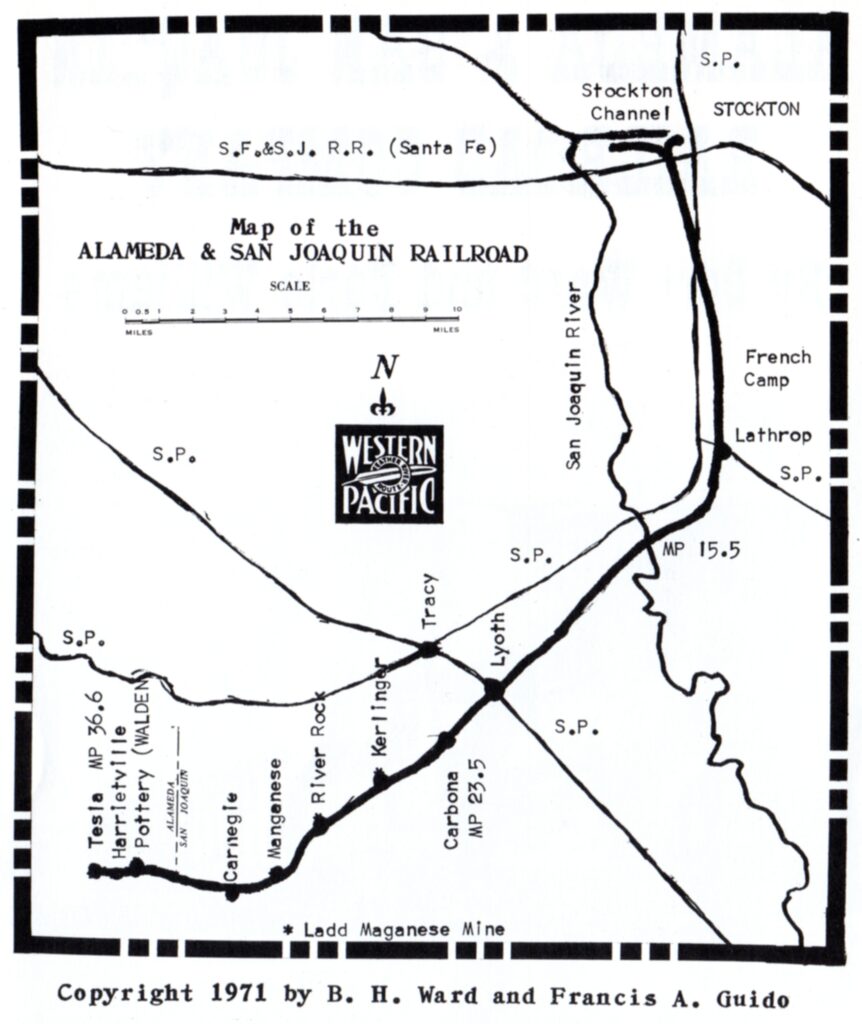
The railroad was known as the Alameda & San Joaquin. Construction began on the line in 1895 at Stockton, while grading work got underway for the A&SJ’s roadbed into Corral Hollow at the opposite end.

When the A&SJ began operations, the station was designated as South Tesla Junction. Under Western Pacific ownership, it officially became Carbona upon the issuance of the WP’s Timetable #1 in January 1910.
From the junction at Carbona, its rails wound in a gentle counter-clockwise arc through Lyoth, Nilegarden, Mossdale, along the edge of Manteca, then up through Lathrop and French Camp and into Stockton, where the line terminated at Stockton’s deep-water channel, a location perfectly suited for the A&SJ to transfer its cargo – mostly soft Tesla coal in those early days.

In October 1962, as indicated on Western Pacific’s Timetable No. 48 (above), the Carbona Branch extended only as far as TeeKay’s manganese pits, less than two miles from the railroad’s depot at Carbona.

NOTE: Following is the text of “Alameda & San Joaquin Railroad” by Bert Ward and Earle Williams, which was published in the October 1971 edition of The Western Railroader. The text is reprinted verbatim from the original Ward and Williams article, with the exception of a few punctuation corrections that do not otherwise alter the narrative.
Bert Ward was a railroad conductor as well as a railfan and photographer of legendary repute; Earle Williams (1898–1983) came to Tracy at the age of twelve and later graduated from Tracy High School.
You could say that Earle had gravel in his blood – he began working in the aggregates industry when he was 16, and he founded the Kerlinger gravel pit and plant (on Corral Hollow Creek, adjacent to Tracy Airport) in 1946.
Mr. Williams was deeply involved in a variety of local history and civic organizations, including the Tracy Chamber of Commerce and the West Side Pioneer Association. He was widely known as the preeminent historian in southern San Joaquin County, and he extensively chronicled Tracy’s earliest days. Williams Middle School on Tennis Lane in Tracy was named in his honor.
From The Western Railroader
For the Western Railfan
Vol. 34, No. 10 – October 1971 – Issue No. 380
In the background of the Western Pacific Railroad of today is a small railroad called the Alameda & San Joaquin Railroad, one of a very few acquired by the Western Pacific during the construction of the last trans-continental link to California.
This little coal railroad was known to its employees as the “Andy & Sam Jackson” and was but 36.6 miles in length from the mines at Tesla to the coal bunker at Stockton.
Coal was its main reason for being, but earth from the mines and nearby pits provided an excellent clay for the making of bricks, pottery and tile pipe, a high grade of silica sand made fine glass and huge gravel beds provided gravel and sand.
The story begins with the discovery of traces of coal on New Year’s Day 1857 by Edward B. Carrell and Captain Jack O’Brien on O’Brien’s sheep ranch at the extreme west end of the gulch of Corral Hollow in Alameda County, adjoining the San Joaquin County line.
The mine location was about 30 miles airline southwest of Stockton and some twelve miles southeast of Livermore. There are three passes through the last ridges of the Diablo Mountains, a spur of the Coast Range, as one descends into the San Joaquin Valley from the West.

The north pass is the Livermore through which the original Western Pacific was built in 1869. The station at the summit was named Altamont at that time. This name is familiarly applied today to this range, and the name of Diablo has almost been lost ln time apart from the mountain of that name to the north.
In later years the present Western Pacific,1 bearing the same name of the unrelated first line which became part of the Southern Pacific, built through the same pass on a gentler grade.
The southern-most exit was the one through Corral Hollow, a link in the old Spanish trail from Rancho San Antonio (Oakland) to San Pedro in the southland.
Patterson Pass was called by the Spaniards “Paso de en Medio” (Middle Pass) because it was between the two other openings in the Diablo range.
Numerous mines, generally small in size, were opened and closed in Corral Hollow following the discovery of coal by Carrell and O’Brien.
Problems were numerous for these mines as the strata were badly disturbed by ancient upheavals and four or five great faults converged in the Tesla area. Shafts sunk or tunnels drilled would often miss the coal veins or the cost of wagon drayage to the San Joaquin River would force the mines to operate at a loss.
In 1870 the original Western Pacific2 built a branch from Ellis Coaling Station,3 where the coal wagon route from Corral Hollow crossed the railroad three miles west of present Tracy, into Corral Hollow, but quit laying track with only four miles spiked down. The point where the spur terminated is on high ground just across the creek from the old “Zink House” that Carrell and his friends had established in 1850.
The railroad brought in a steam shovel and opened a gravel pit for ballast and bank-widening. Coal was also transferred here from wagons to the cars of the railroad. Old redwood ties embedded in this shovel pit were still in good condition one hundred years later, though the rails were removed years ago.
The crossing of the Santa Fe, which at that time was the newly built San Francisco & San Joaquin Valley Railroad Company, was protected with a semaphore and signalman. The little road’s telegraph system was a two-wire line belonging to the Postal Telegraph Company from Stockton to Fitzsimmons. From this point to Tesla it was a single wire on poles owned by the railroad.
Ballast came from the Treadwell’s4 own gravel pit in Corral Hollow. In Stockton, on Mormon Channel, the railroad built a large coal bunker which carried the name “Tesla Coal” in large white letters. Here, barges and river steamers could coal up as well as transport the commodity to the Bay Area.
Also at Stockton, a briquette plant was built which used oil to bind the soft coal and its dust. This item was sold in Stockton and was used by the A.&S.J. locomotives as well. It did not fire too cleanly as Dan McKellips, one of the road’s two engineers, reported that it was necessary to clean the firebox grates half way up the hill to Tesla.
Construction was easy from Stockton south and southwest until the bottom lands of the San Joaquin River were reached. Here the contractor built the railroad up on a fill until near the river channel where piling was driven for trestle work to the river’s edge.
The reader’s attention is called to the fact that the City of Stockton is not on the main river, but at the end of a navigable channel. On reaching the river, the Pacific Bridge Company erected an 80-foot steel-approach truss span which led to the draw or shore pier. The shore piers were steel cylinders, while the channel pivot pier was of concrete and octagonal in shape, each face being 8 feet 9 inches in width.
The arms of the swing span reached out 108 feet from the center of the pivot pier, giving river steamers and barges some 90 to 95 feet of clearance. This stout bridge was built in 1895 and is unchanged today except that steam boats do not use the river any more and the swing span is welded in place. Today it serves the heavy freight trains of the Western Pacific Railroad Company. This attests to the enduring construction of yesterday’s builders.
Because the water supply at Tesla was hard and unsuitable for boilers, the railroad had a 15,000-gallon tank at the west end of the bridge. A steam boiler and pump in charge of a pump man kept the tank filled to supply soft water to the locomotives and for tank cars to be hauled to Tesla for use in the boilers there. Condensers were also used by these industries to recover some of their needed water.
Lyoth,5 two miles southeast of Tracy, was the junction and crossing of the Southern Pacific’s west-side line that ran down the San Joaquin Valley to Fresno. At this junction interchange was made from the A. & S.J, via the siding on the north side of the little road’s main line.
The grade up to Tesla began at milepost 23, measured from Stockton, and was 13.6 miles below Tesla. Here the grade began and rose to a maximum of 68 feet to the mile. Curves of not less than 10 degrees were protected by steel bracing. Trestles were of Oregon Pine, cuts were made through hills of slate or sandstone, and the railroad threaded its way up Corral Hollow Canyon.
Tilted strata can be seen in this area, and in one place there is a blue sandstone strata folded into a “U” formation holding in its center a bed of soft clay. The normal tilt of the strata in the Tesla region ranges from 40 to 70 degrees reaching down to the north.
In this region, at approximately milepost 29, a branch was contemplated up Mitchell’s ravine to the south to the Ladd Manganese mine, which would have been about 1½ miles in length over an easy grade. The manganese deposits ranged east and west from this ravine and were worked on and off for many years.
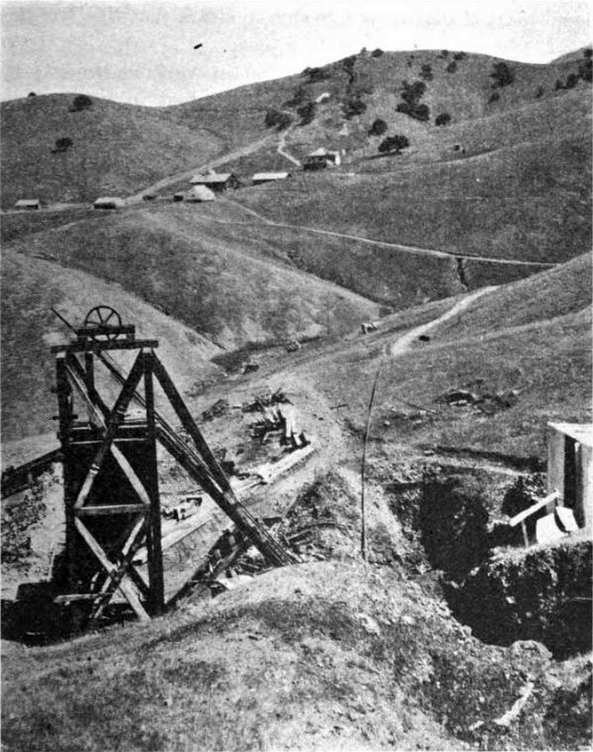
(From the California State Mining Bureau’s “Manganese and Chromium in California” report, published in 1918.)
Several thousand tons had been mined and shipped to England in 1867, being teamed on coal wagons to Mohr’s Landing on the Old River, and loaded on ocean going ships there. Mohr’s Landing was the first tidewater landing on any of the inland waterways of San Francisco Bay. High tides reached a spot just one-half mile below the A.&S.J. bridge.
Forty cars of manganese ore were shipped over the railroad in 1904 and were found to be very satisfactory. No additional shipments were made since the shipping tariff was excessive. These mines were worked for their manganese during World War I with a government subsidy, cars being loaded at milepost 29 of what was then the Tesla Branch of the Western Pacific Railroad. They were worked again during World War II, but the ore was trucked to Tracy for loading onto the cars of the Southern Pacific.
At milepost 29, a spur track took off into the wide gravel beds between there and Carnegie, a distance of a mile on the south side of the main line. These were the gravel beds from which the Company made shipments over the A.&S.J. until 1911, when a great torrent in Corral Hollow Creek wrecked the five railroad trestles in the lower canyon.
Gravel loaded on the cars with a steam shovel earned the Treadwells twenty-five cents per ton. The freight rate to Stockton was the same. The 80,000 pound capacity sideboard flats on which most of the gravel was loaded had wooden sills, and rough handling would collapse them. For this reason, the rails would call these cars “crushers”. These gravel pits were the last producing segment of the Treadwell industrial complex. They were shut down late in 1910 because of the collapse of the trestles and of the parent company.
In another period of high water, in the spring of 1907, Engineer McKellips left Stockton with an A.&S.J. train only to find a trestle washed out a little west of the San Joaquin River bridge. So he backed the train into Stockton and came out over the Southern Pacific to Tracy, then down its west side line to the interchange, then over the Andy & Sam Jackson to Tesla. It was five weeks before he got home as he shuttled his train from Tesla and the S.P. interchange. During this period he stayed in the hotel at Tesla.
Returning to the Treadwell pits before they were shut down, they supplied gravel to pave over 80 blocks in the downtown section of Stockton, thus for the first time “bringing Stockton up out of the mud”. The Santa Fe and its predecessor, the San Francisco & San Joaquin Valley R.R., used 10,000 carloads of gravel from these pits, shipped out over the Andy & Sam Jackson.
One day in wartime 1917, the River Rock Plant, about four miles from the Treadwell pits, but not owned by them, produced 107 heavy carloads of gravel in a single day! Co-author Earle Williams loaded most of them in an 18-hour day using a steam-powered Ohio locomotive crane with a clamshell bucket.
Earle worked his way up to manager of the plant under the Pacific Coast Aggregates Corp. This plant was built by Ford & Plummer of Niles at the time of the earthquake of 1906. We shall consider this operation later.
The railroad at the manganese loading point had entered Corral Hollow gulch, and this point was three-tenths of a mile within the gulch. One and a half miles farther west, with the track following up the north side of the gulch, with the gravel pits on the left, the rails came to Carnegie. Three and a half miles farther to the west was Tesla, end of the line and end of the gulch.
The Pottery plant, served by the Walden Spur of the railroad, was about midway between Carnegie and Tesla. Harrietville, consisting of forty-eight cottages for workmen and a schoolhouse, was about midway between the pottery plant and Tesla.
Corral Hollow canyon, running east and west, is about five miles long. Between Carnegie and Pottery, on the hills to the north of the railroad, were more than a dozen neat brick homes for workmen who worked in Carnegie.
Local transportation between Tesla and Walden was supplied by a large, four-wheel flat car, gravity operated, carrying some fifty to sixty persons to work or to school over the one-and-eight-tenths mile route. The journals were kept well oiled, and a slight push started the car down grade. Brakes were wooden four-by-fours inserted in holes in the floor of the car and levered against the wheels.
In the late afternoon the return trip was made with the aid of a white horse. The boy from the livery stable in Tesla rode the animal down and hitched onto the car loaded with workers for Harrietville and Tesla, plus any other wayside stops.
When there was a dance at Carnegie, special trips would be made down by gravity car and the return, of course, under animal power. Such operation was dovetailed to the times when the steam trains were not in the vicinity, but there were instances where the two saw each other, but no record is to be had of any disastrous meets.
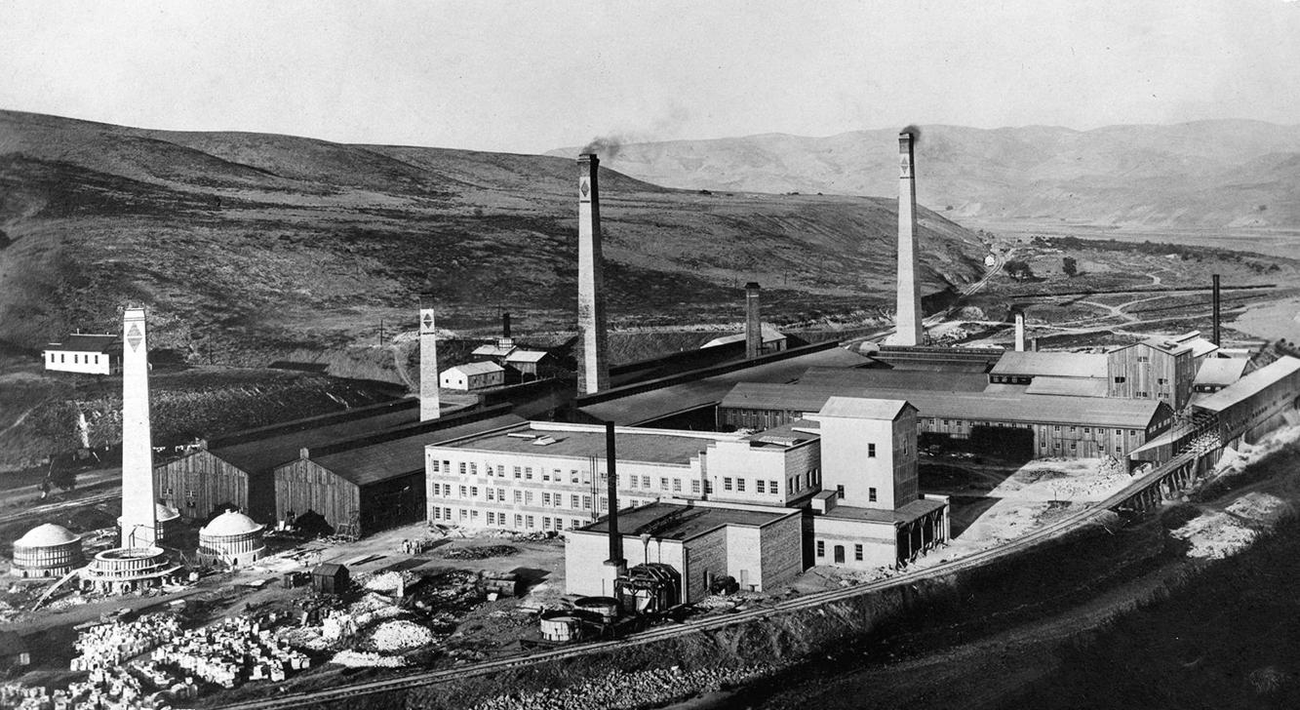
The Carnegie Brick & Pottery Company operated both the Carnegie and Pottery plants as one unit, bringing down clay for both operations from the Tesla mine, starting in 1895.
The Carnegie plant was enlarged in 1904 to a total of eight thirty-foot diameter kilns, three small kilns and four muffle kilns. These last named were the ones that produced terra cotta tile.
Then there were fifteen dry kilns, each 125-feet long. One of the pressed brick machines would produce 20,000 bricks per day. The factory was powered by a big Corliss engine built by Hinckley, Spiers & Hays of San Francisco in 1882, using steam from three “Elephant” boilers constructed by the Union Iron Works, also of San Francisco.
These boilers blew up one Sunday in 1907 with the complete destruction of the boiler room.

Water in part came from artesian wells nearby, but even with the use of condensers water was always in short supply at Carnegie. Also it was hard water and had to be augmented with softer river water.
The boiler fireboxes were to be fired with coal from the mines, but they actually burned oil in order to give an even temperature, a fact that the company did not wish to be known. This heating situation also applied to the firing of the kilns as well.
Another item constituting a large output was the manufacture of locomotive fire brick.
Still another product was high-grade limestone, obtained from the crest of the hill about a quarter mile from the brick plant on the south side of the railroad. Production was about 75 barrels per day. Nearby, a small smelter beside some deposits of cinnabar supplied flasks of quicksilver to be shipped out on the Andy & Sam Jackson RR.
The Pottery Plant on Walden Spur was smaller than the Carnegie operation. It had eight kilns served by two smokestacks and produced figurines, cornice tiles, porcelains and pottery. This plant had similar machinery for its operation but had two oil-fired “Elephant” boilers.
The 1906 earthquake did considerable damage to this plant, but repairs were immediately made and the factory was back in operation in a short time. An unusual earlier product was beautiful glazed porcelain headrests for the Chinese, who used them as pillows when sleeping to protect their queues. This was a specialty of the Pottery Plant. Clay was obtained from a pit in the rear of the complex.
The works were staffed mostly with Italian laborers and artisans from Milan, Italy. Surface workers at the Tesla mines were usually Chinese, while the miners, some 400 of them, were mostly Welshmen who had drifted down from the Mount Diablo mines to the northwest. The bakers at Carnegie who made the French bread were Japanese, while the restaurant cooks were Chinese.
The latter two groups supplied apprentices for the Palace Hotel in San Francisco which John Treadwell had built.6
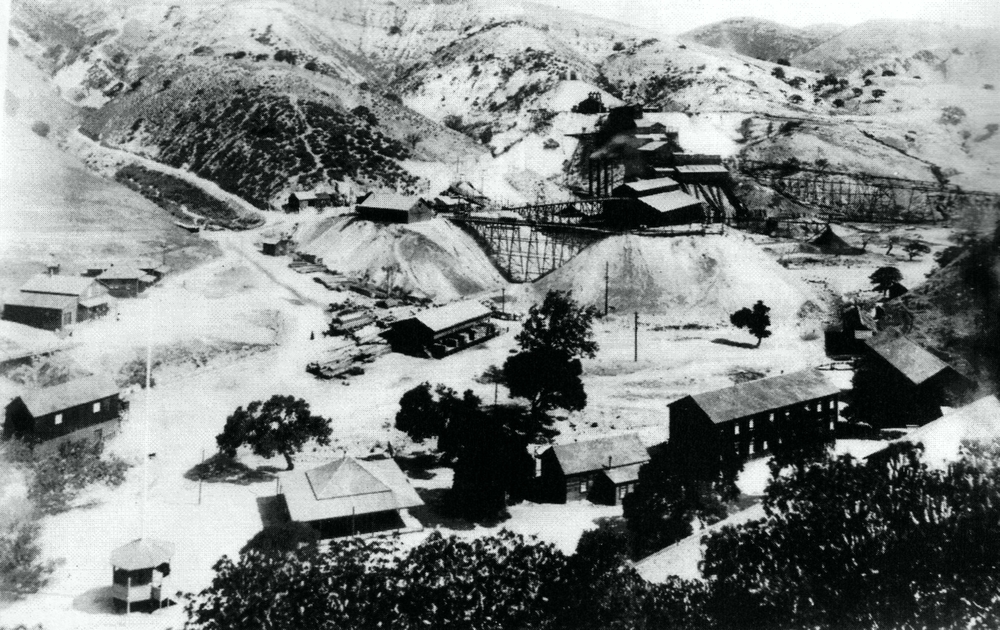
The heart of the Treadwells operation was, of course, the coal mines and the complete company-owned town of Tesla which surrounded them. The slope, or shaft, went down into the mountain at an angle of some 80 degrees, feeding miles of tunnels running in the four directions of the compass.
At first mine mules were used. Their stable was a huge, hollowed-out cavern to which hay and grain was brought down to them. The coal at the 400-foot level was good, while that at the 500-foot level was good blacksmith coal. Actually it was not the best and it ran in seams of 15 to 30 feet in thickness.
In strata beside the coal seams were to be found various types of clay. Some forty-five types have been catalogued. Then, too, there was high grade quartz sand, ideal for glass making. Daily output of coal reached 500 tons, while the annual output for 1897 to 1902 was about 90,000 tons. The quartz sand was in a seam 60 feet wide in the mine.
There was no record of a man injured at the mine or of being lost due to a mine accident. Great double doors in the main shaft opened and closed at the change of shifts as a ventilation control measure. Vertical air shafts were drilled from the mountain top as the shafts progressed. Powerful fans exhausted the methane gas and other fumes, so that the men worked under good conditions.
A sawmill, powered by electricity, was maintained for cutting and shaping mine timbers. These precut timbers saved a lot of time in the mine. In time the mules were replaced by electric mine locomotives powered by direct current overhead trolley lines.
Tracks in the main tunnel were double tracked. Electric power was generated by the boiler plant and a huge Corliss engine driving the generators. The direct current was also used for street lighting, illuminating the mine, and in some of the buildings. Steam was piped from the boiler plant to the Tesla Hotel for use in the kitchen for cooking.
The company-owned general store, a large one, served the entire community. Near the store was the livery stable and stage station for the difficult line operated by the Ryan Brothers coming in from Livermore.
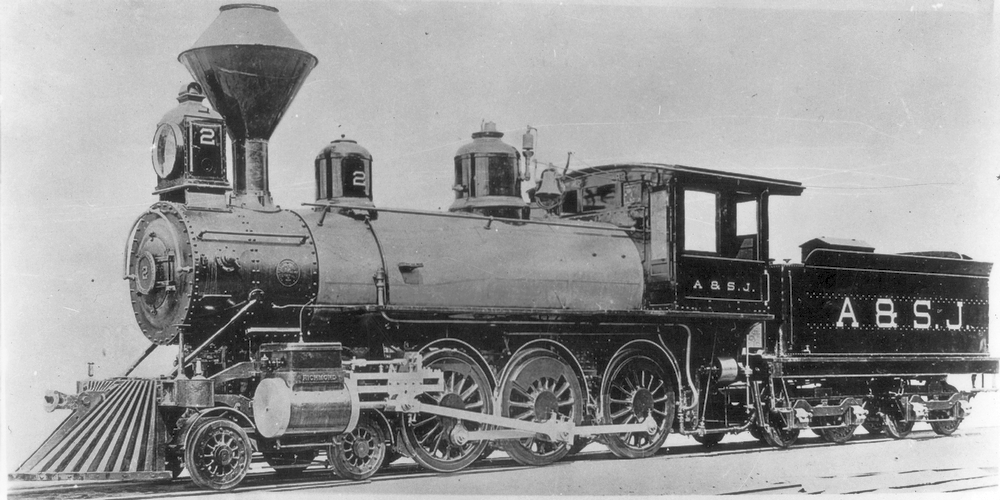
(Broadbelt Collection, courtesy of Dan Shelburne)
Now, to consider the Andy & Sam Jackson’s motive power. The road operated two ten-wheel locomotives (4-6-0) from Richmond Locomotive Works, both built in 1906. Both engines were identical, having 18″ x 24″ cylinders, 57″ drivers and weighing 80½ tons. They carried a boiler pressure of 150 pounds per square inch and developed 17,400 pounds tractive effort.
A difference did exist in that No. 2 was delivered with a squat balloon stack while No. 1 came with a straight capped stack. Apparently No. 1 was re-equipped with a balloon stack as well, for the region the line traversed was covered with dry grass most of the year in the semiarid mountains of the Diablo range.
At Tesla the engines were turned on a 60-foot sheave and wire rope turntable. The engine house was at Stockton where a wye was built. With the engines were 20 gondola dump cars of 60,000 pound capacity, three water cars, three refrigerator cars, four box cars, one oil tank, 63 sideboard flat cars and one caboose.
The caboose was for a time the line’s only passenger carrying vehicle. This business, until 1904, was handled by the stage line. The 1904 report gives the railroad a passenger car.
There was a third engine on the A.&S.J. which had been brought in by the contractor and was leased to the railroad following construction. The existence of this engine was confirmed in reports of the Interstate Commerce Commission of 1905, which assigned the locomotive to the coal road. It was a 2-6-0 Baldwin engine, and appears to have been assigned to switching service at Tesla. This engine did not become the property of the Western Pacific Railroad when it took over the Andy & Sam Jackson.
The coal seams were fairly well played out by 1902, and activity of the plants at Walden Spur and Carnegie began to taper off from this date through 1911. Nevertheless the plants produced heavily until the earthquake and fire of 1906 caused this city and Oakland to use other forms of sewer pipe.
Reverses in finances from the depleting of the mines’ coal, flood damage of 1907 and 1911, plus damage done by the 1906 earthquake in the Tesla area and the failure of the California Safe Deposit Company, an old banking institution in San Francisco, combined to wreck the Treadwell’s empire.
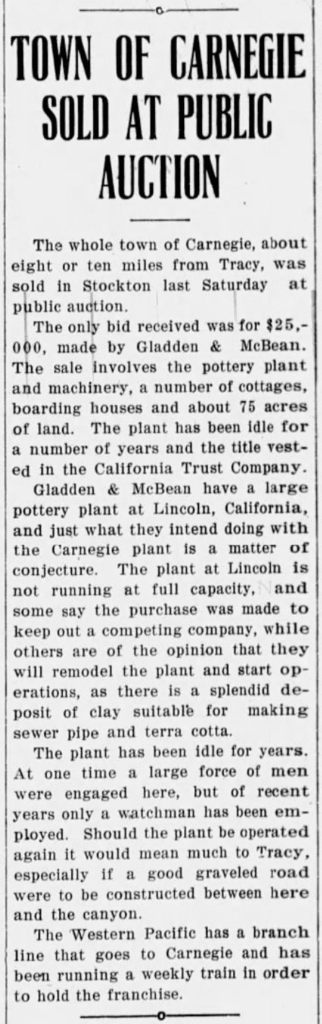
By 1916 it was all over, with the Carnegie plant being sold to Gladding, McBean & Company, who dismantled it to keep out competition. The Tesla operations went to the Beckman-Linden Corporation in 1919.
The Walden plant was dismantled as was the Treadwell’s gravel operation. The thirteen huge smokestacks at Carnegie were blown up, while the stores and homes were carted out of the valley piece by piece.
The United States Railroad Administration ordered the railroad to be terminated at Carnegie in 1918, but the rail remained all the way to Tesla. It laid there until 1922 when it was removed from Tesla to Moy. Moy was four miles west of Carbona, which left room for storage as well as switching at the gravel plant of the Pacific Coast Aggregates Company at Kerlinger.
This particular operation, after starting with steam equipment, converted its cranes and railroad to electric power. Its saddle tank locomotive was displaced by a four-wheel electric engine operating from a third rail. This changeover took place in 1918 while the plant was still doing business under the title of River Rock Gravel Company.

When necessary to run the electric locomotive beyond the third rail, it had the use of 200 feet of electric cable so it and its “grizzly car” could reach the scene of the electric shovel with its 2½ yard clam shell type bucket. This operation remained on the Carbona line until after World War II, when it was closed in favor of other P.C.A. plants.
The officials of the Alameda & San Joaquin Railroad were the Treadwells, with John as the General Manager and James as Director. Also, R.D. Fry was the President, H.A. Williams, vice-president, J.D. Brown, treasurer, B.M. Bradford, secretary, and S. Johnson, master mechanic.
It is interesting to note that John and James Treadwell were two of the original twelve stockholders in the Western Pacific Railway when it was incorporated in March 1903. When the W.P. acquired the A.&S.J. in 1906, it was found necessary to relay the line with heavier rail from Stockton to Carbona, which amounted to 22 miles.
In Stockton, the W.P. found it desirable to enter and leave the city to the east of the Southern Pacific tracks, whereas the A.&S.J. crossed the S.P. outside the city and ran up Hunter Street. This street was later used by the electric trains of the Tidewater Southern, which left Stockton for Modesto and way stations. The electric trains used the old Andy & Sam Jackson crossing of the Southern Pacific en route to and from Stockton.
The A.&S.J. engines numbers 1 and 2 became the W.P.’s 121 and 122, with the 121 being out of service for some time before being dismantled in 1930. It had been burned in an engine house fire in Stockton some years before the consolidation.
Engine 122, after ceasing to operate over the A.&S.J., worked the W.P. Terminous7 Branch, hauling vegetables to Stockton, then later saw much service on the Tidewater Southern when that line ceased its electric operation, except for that portion in Modesto. It survived until 1950, when it was replaced by diesel locomotives.
Edited for original publication by Edward Planer and Francis Guido.
Copyright © 1971 by B.H. Ward and Francis Guido.
Unless otherwise noted, photo and image credits are as originally shown in the 1971 edition.
For ease in reading on this website, some lengthy paragraphs were shortened, but the original text was not altered beyond basic punctuation, which was added for clarity.
Additional information in this article was sourced from “72-82: Western Pacific’s Final Decade,” a remarkable treasury of photographs and stories brilliantly and lovingly compiled by by Ted Benson, Dick Dorn, Dale Sanders, Dave Stanley, and Dale Sanders. It is required reading for all Western Pacific fans, if not for railfans in general.
- The “present Western Pacific” mentioned here is the second railroad to have incorporated that name; the first was a section of the transcontinental Central Pacific, which later operated here as the Southern Pacific. The second Western Pacific was absorbed by the Union Pacific in 1982; the Southern Pacific was merged into the UP in 1996. – DJ
- As noted previously, the original Western Pacific was part of the Central Pacific’s transcontinental empire; it later operated as the Southern Pacific. – DJ
- The original site of Ellis was along present-day Western Pacific Way, between Corral Hollow and Lammers roads. The modern-day residential community called “Ellis” was named in honor of the original coaling station site, but is otherwise unrelated by history or geography. – DJ
- “Treadwell’s” (sic) is (or are) not identified prior to this point in the original text; however, it is mentioned much later in the text that the officials of the Alameda & San Joaquin Railroad included “the Treadwells, with John as the General Manager and James as Director.” The Treadwell brothers made their fortune in Klondike gold, and later purchased the dormant coal mining operation at Tesla. – DJ
- Spelled incorrectly as “Lyeth” in the original text, Lyoth is the “diamond” on the backside of the Defense Depot in Tracy. For many years, an interlocking tower operated by the Western Pacific stood guard over the crossing with the Southern Pacific. – DJ
- Bricks stamped “Carnegie” were used in part to build Treadwell’s Palace Hotel. According to a March 2016 article in the Tracy Press by Sam Matthews, “Even today, bricks and terra cotta decorative ornamentation from Carnegie grace the fronts of the historic Palace Hotel in San Francisco.” – DJ
- Spelled incorrectly as “Terminus” in the original text. The Western Pacific’s Terminous Branch ran from a wye near Kingdon, paralleling Highway 12 to the San Joaquin River, ending at the present-day location of the Tower Park Marina.

These articles are very interesting. I have been looking for the history of the Tracy railroad system and you all have gathered it and presented it in a great way. I really enjoy learning about this stuff. Thank you!